
WORLD RELIGIONS
Understanding Religion and Religious Literacy
Religious Literacy
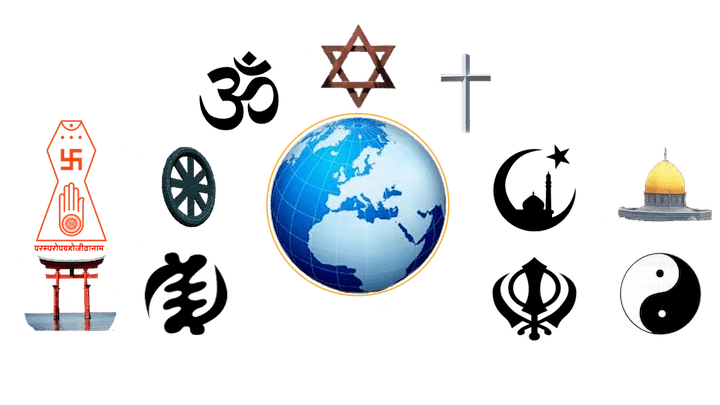
Have you ever wondered why 85% of the global population identifies with some form of a religious tradition? Religious literacy involves our ability to participate in ongoing conversation about the private and public place of religious beliefs and practices.
Understanding religion is a benefit to our shared world and to the advancement of society. Knowledge of religion helps us understand culture, politics, nationhood and our place in global citizenship. It helps us see the human person as a spiritual being who seeks ultimate meaning in life and to see religion as providing that meaning.

The Unaffiliated
The other important thing we need to recognize in the study of religion is the emerging phenomenon of religious unaffiliates. Research shows that about 16% of the world population (1.1 billion people) have no religious affiliation.
The unaffiliated forms the third-largest religious group worldwide, after Christians and Muslims. Interestingly, research has shown that decline does not mean people are rejecting religion. Religious commitment remains relatively stable even though the unaffiliated continue to reject organized faith.
What is Religion?
Before we can experience individual religions of the world, we should also define religion. Can religion be defined simply as a belief in the realm of the supernatural? How about religions in which the idea of gods and spirits is absent?
We will investigate together how people have understood religion in history. Eventually we will introduce you to new ways of understanding religion and religions of the world.
PRICING
Satisfaction Guaranteed
Explore the Curriculum
Active courses and what is coming next

What is religion, and why has it shaped every civilization that ever existed? This course explores the roots of belief, the nature of religious literacy, and why faith still defines how we live, lead, and search for meaning.

One of the world's oldest living faiths, Zoroastrianism gave humanity its first framework for good and evil, light and darkness. Meet Zoroaster — the ancient prophet whose ideas still echo inside Judaism, Christianity, and Islam today.

Judaism is an enduring and living religious tradition that has undergone markedly transformation over the millennial. Every Jew cherish the Torah knowing that God is not just found in natural forces but also in moral meanings.

The early Christians were part of the first-century Jewish community who were privy to the teachings of the Jewish narratives recorded in the TaNakh. Jesus was born in Bethlehem in fulfilment to the Hebrew Bible prophecies.

Islam derives its meaning from the root s-l-m meaning "peace". It also denotes "surrender". Islam means complete, trusting surrender to God. The followers of Islam see Islam as the original path of monotheism.

Hinduism is not unitary or monolithic. Hindu is more a geographical than a religious term referring to the people who lived beyond the river Indus distinguishing them from Muslims.

Founder and CEO
Kasisi Kĩriakũ wa Kĩnyua
Kasisi Kĩriakũ wa Kĩnyua is the founder and CEO of Kasisi Brands including Kĩriakũ Teaches, Radio Kenya United and Kasisi Facing Mount Kenya. He is a trained theologian, a motivational speaker, a professor of religion and ethics, and an ordained minister.
Kasisi Kĩriakũ holds a PhD degree in Religion from the University of Birmingham (England). Kasisi is the author of: Bible Translations into Gĩ-Gĩkũyũ (2017) and Introducing Ordinary African Reader's Hermeneutics (2015).
PUBLICATIONS
Books & Articles
Johnson Kĩriakũ Kĩnyua, "Online Learning and The Future of Adult Learning in Kenya", Kenya Scholars & Studies Association (KESSA) 2018 Conference Proceedings, (The 11th KESSA Conference September 7 - 8, 2018)
Johnson Kĩriakũ Kĩnyua in Dube, Musa W. and R. S. Wafula, eds. "Postcolonial Analysis of Bible Translation and its Effectiveness in Shaping and Enhancing the Discourse of Colonialism and the Discourse of Resistance: The Gĩkũyũ New Testament, A Case Study", Postcoloniality, Translation, and the Bible in Africa 2017, 57-93
Johnson Kĩriakũ Kĩnyua, "The Role of Technology in Remembering and Re-Membering African Memory (ies) among the Kenyan Immigrants Living in the Diaspora". Kenya Scholars & Studies Association (KESSA) 2016 Conference Proceedings (The 9th KESSA Conference September 9 - 10, 2016)
Johnson Kĩriakũ Kĩnyua, "A Postcolonial Examination of Matthew 16:13-28 and Related Issues in Biblical Hermeneutics", Black Theology: an International Journal, vol. 13, no. 1, 2015
Johnson Kĩriakũ Kĩnyua, "Postcolonial Analysis of Bible Translation and its Effectiveness in Shaping and Enhancing the Discourse of Colonialism and the Discourse of Resistance: The Gĩkũyũ New Testament, A Case Study", Black Theology: an International Journal, Volume 11, no. 1, 2013, 58-95
Johnson Kĩriakũ Kĩnyua, "The Narration of Egyptian Mythology: Wilhelm Max Müller through a Postcolonial Lens", Black Theology: an International Journal, vol. 11, no. 3, 2013, 323-341
Student Testimonials
"Dr. Kiriaku's approach to teaching world religions opened my eyes to the interconnectedness of all faiths. Truly transformative."

Michael Thompson
High School Teacher
"The course provided deep insights into religious literacy that I use in my professional work every day."

James Mitchell
International Relations Analyst
"An excellent foundation for understanding the role of religion in our global society. Highly recommended."

David Rodriguez
Graduate Student
"The course's exploration of religious literacy has been transformative for my work in social services. Understanding the spiritual needs and backgrounds of diverse clients has made me a more effective counselor and advocate."

Sarah Chen
Social Worker
"Dr. Kiriaku's academic rigor combined with genuine respect for all traditions created a learning environment where I could explore questions I'd had for years. The course helped me understand my own faith journey while appreciating others' paths to meaning."

Aisha Williams
Nonprofit Director
"Working in healthcare, I encounter patients from many religious backgrounds. This course gave me the cultural competency to provide more compassionate care while respecting diverse spiritual needs and practices during difficult times."

Yuki Tanaka
Registered Nurse
Get In Touch
Have questions about our courses or want to learn more? We'd love to hear from you.